How-to guide
Wiring a new radial and need to know whether 2.5, 4 or 6 mm² twin and earth will do - and on what breaker? The free Cable Sizing Calculator's UK mode works it through the BS 7671 way, using the Table 4D5 ratings for how the cable is installed. It runs in your browser, with nothing to install.
Open the calculator and set Cable type to UK twin & earth (BS 7671). It covers 1.0 to 16 mm² flat twin and earth on a single-phase supply.
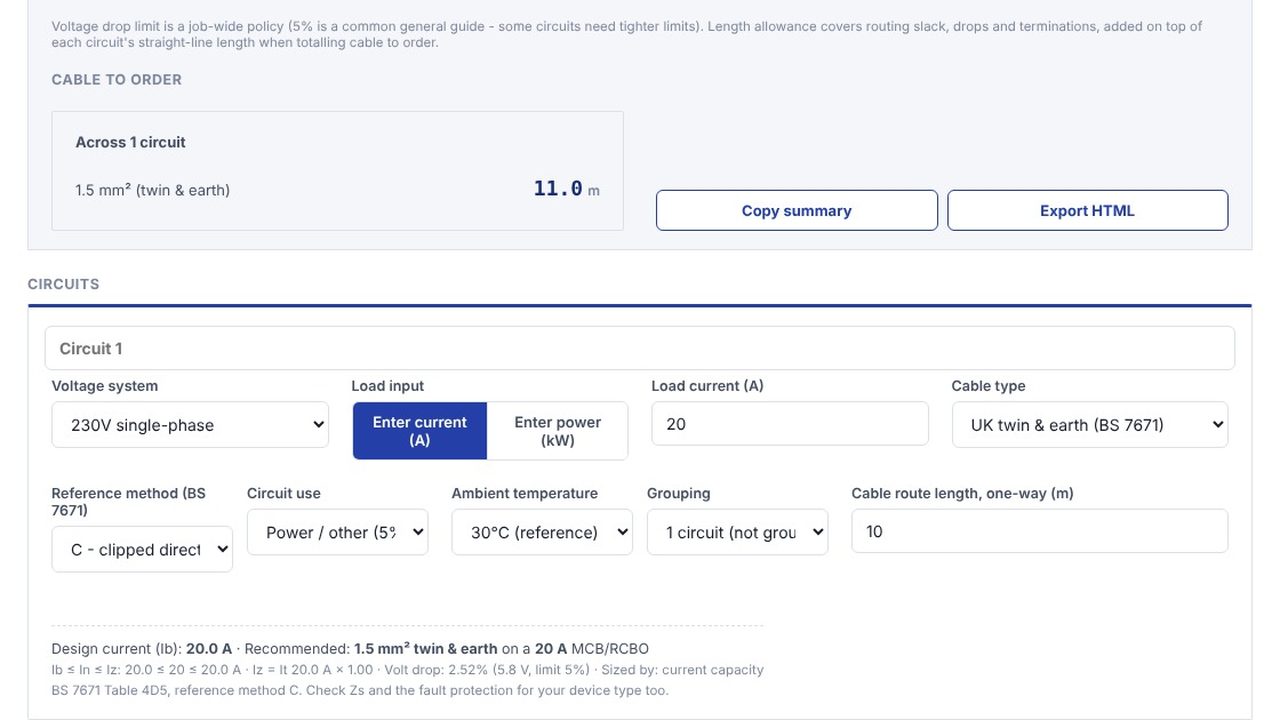
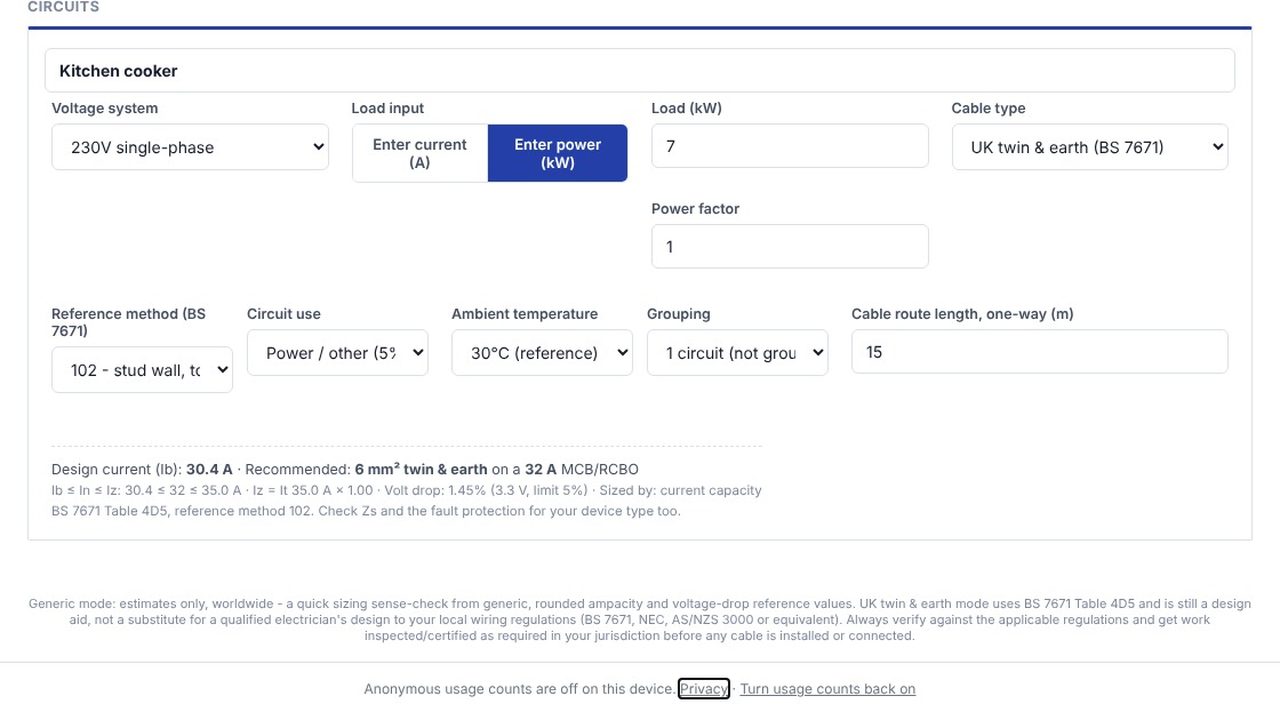
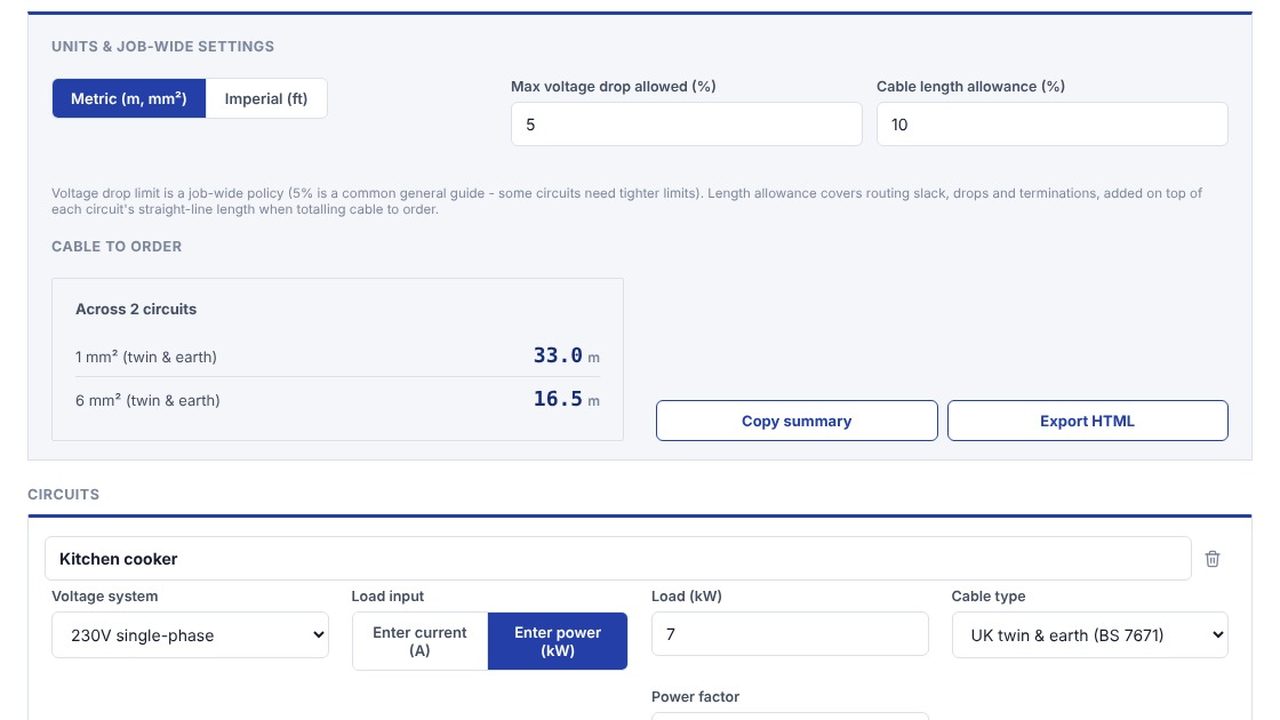
Name the circuit and enter its design current (Ib) in amps - or switch to Enter power (kW) and give the load and power factor. A 7 kW cooker at 230 V is 30.4 A. Use the current the circuit will really carry, after any diversity you're allowed to apply.
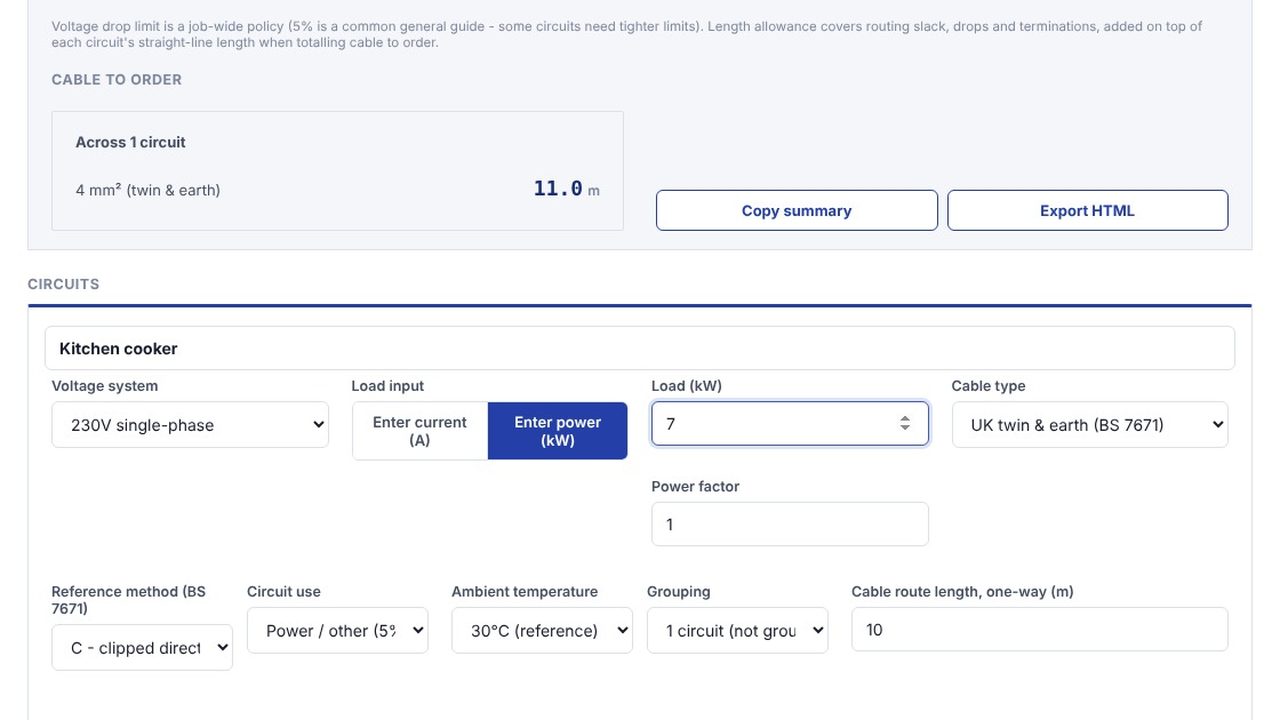
Choose how the cable is installed - this changes its rating more than anything else. C is clipped direct or buried in plaster; A is in conduit in an insulated wall; 100 and 101 are above a plasterboard ceiling under up to, or over, 100 mm of insulation; 102 and 103 are in an insulated stud wall, touching or not touching the inner face. Then enter the one-way route length.
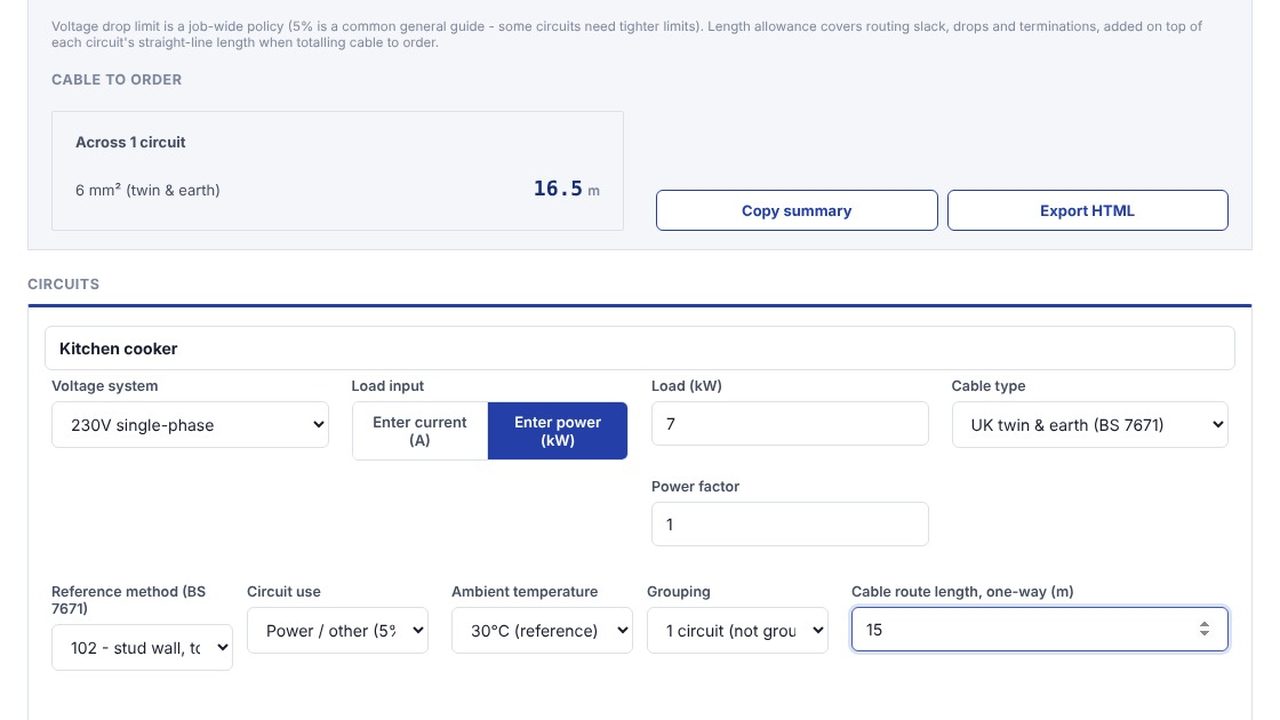
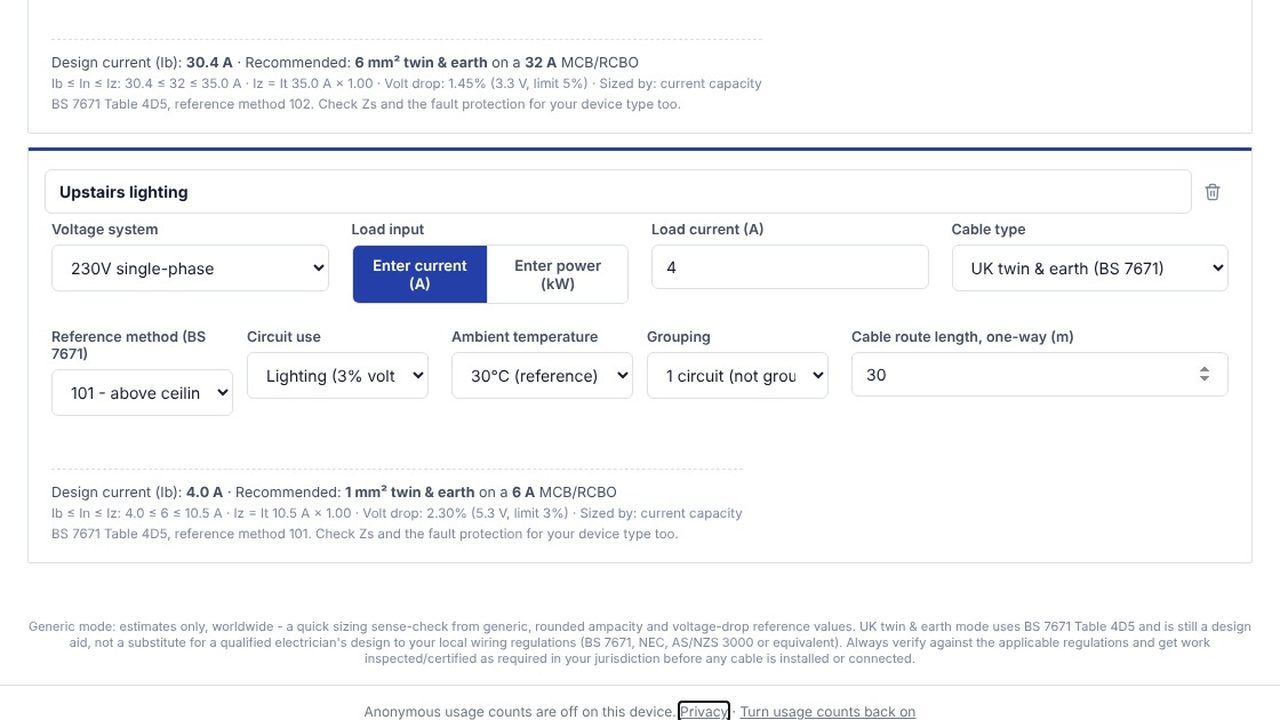
The calculator picks the protective device first - the smallest common MCB or RCBO rating at or above Ib (In) - then the smallest cable whose rating for that method, after the temperature and grouping factors, is at least In (Iz). That's the Ib ≤ In ≤ Iz rule. It also checks volt drop at Ib. Here the cooker needs 6 mm² on a 32 A breaker: 4 mm² is only 27 A in a stud wall, method 102.
Choose + Add circuit for the next one. Set Circuit use to Lighting and the volt drop limit drops from 5% to 3%. A 4 A lighting circuit with a 30 m run above a ceiling under thick insulation (method 101) comes out at 1.0 mm² on a 6 A breaker, with 2.3% volt drop.
Cable to order adds up each size across all your circuits, with an allowance for routing slack and drops (10% unless you change it). Copy the summary or export it as an HTML page to keep with the job.
Yes. It's free in your browser with no sign-up, and there's a free Windows app in the Microsoft Store too. It works offline once loaded.
No. It's a design aid that follows the BS 7671 method for twin and earth, not a substitute for a competent person's design, inspection and testing. In England and Wales, adding a new circuit is notifiable work under Part P of the Building Regulations.
Either the breaker size pushed it up (the cable has to be rated for In, not just Ib) or volt drop over the run length did. The line under each result says which.
UK twin and earth mode is single-phase only. For three-phase, aluminium or other cable types, the Generic mode gives a rough worldwide estimate from rounded reference values.