Worldwide cable sizing estimator
Size cables from load and route length - current capacity and voltage drop together, copper or aluminium, any voltage system. Multiple circuits in one job, with a cable-to-order total by size.
A fast check for a single 230 V circuit in flat twin & earth (6242Y), clipped direct. For other installation methods (in insulated walls, above insulated ceilings, in stud walls), grouping, the breaker size and multi-circuit jobs, open the full calculator in UK twin & earth mode - it uses the Table 4D5 rating for each reference method and applies Ib ≤ In ≤ Iz. Three-phase, armoured and aluminium cable use its Generic mode.
Design current, route length and cable size.
BS 7671 Table 4D5, 70 °C thermoplastic, reference method C (clipped direct), 30 °C ambient, no grouping.
| Size | Current rating | Voltage drop |
|---|---|---|
| 1.0 mm² | 16 A | 44 mV/A/m |
| 1.5 mm² | 20 A | 29 mV/A/m |
| 2.5 mm² | 27 A | 18 mV/A/m |
| 4 mm² | 37 A | 11 mV/A/m |
| 6 mm² | 47 A | 7.3 mV/A/m |
| 10 mm² | 64 A | 4.4 mV/A/m |
| 16 mm² | 85 A | 2.8 mV/A/m |
Voltage drop limits are BS 7671 Appendix 4 for installations fed from the public supply: 3% for lighting (6.9 V) and 5% for other uses (11.5 V) at 230 V. Ratings fall when cables are grouped, run through insulation, or in hotter places - a quick check, not a design. Electrical installation work must be designed and verified by a competent person to the current edition of BS 7671.
Enter a load directly in amps, or as power and power factor - the recommended cable satisfies both derated current capacity and your job's voltage-drop limit, whichever needs the bigger cable.
230V single-phase, 400V/415V three-phase, 120V/240V US split-phase, 480V, or a custom voltage - copper or aluminium conductors, metric or imperial units.
Add every circuit in a job and see the total cable length to order, grouped by size - no separate tally per circuit.
Correction factors for ambient temperature, how many circuits are grouped together, and installation method (clipped, enclosed, buried, tray) all derate the cable before a size is chosen.
Name each circuit for a job that reads back clearly, then copy a plain-text summary or export the whole job as a standalone HTML file to keep, print or send on.
A layout that spreads across a wide window, a light/dark toggle that remembers your choice, and a rotating set of realistic sample jobs to load and explore.
Trimble's electrical design software (formerly Amtech ProDesign/Cable Calc) is the well-known professional package UK electrical consultants use for BS 7671 cable design across a whole installation - here's how a focused, one-off contractor tool compares.
| Feature | Cable Sizing Calculator | Trimble Cable Calc |
|---|---|---|
| Pricing model | Free | Enterprise licence, custom quote (no public pricing) |
| Works fully offline | ✓ | ~ |
| Instant standalone circuit check, no project setup | ✓ | ✕ |
| Multiple circuits rolled into one cable-to-order total | ✓ | ✓ |
| Full electrical schematic design & compliance certification | ✕ | ✓ |
| Manufacturer cable database integration | ✕ | ✓ |
| Built for a quick contractor sense-check rather than a design engineer | ✓ | ✕ |
| Requires specialist training to get full value | ✕ | ✓ |
Comparison based on Trimble/Amtech's publicly listed product information as of August 2026 (trimble.com, mep.trimble.com, amtech-power.co.uk) - features and availability change over time, so check trimble.com for current details. Trimble and Cable Calc are trademarks of their respective owner; this comparison is for informational purposes and isn't sponsored by or affiliated with Trimble.
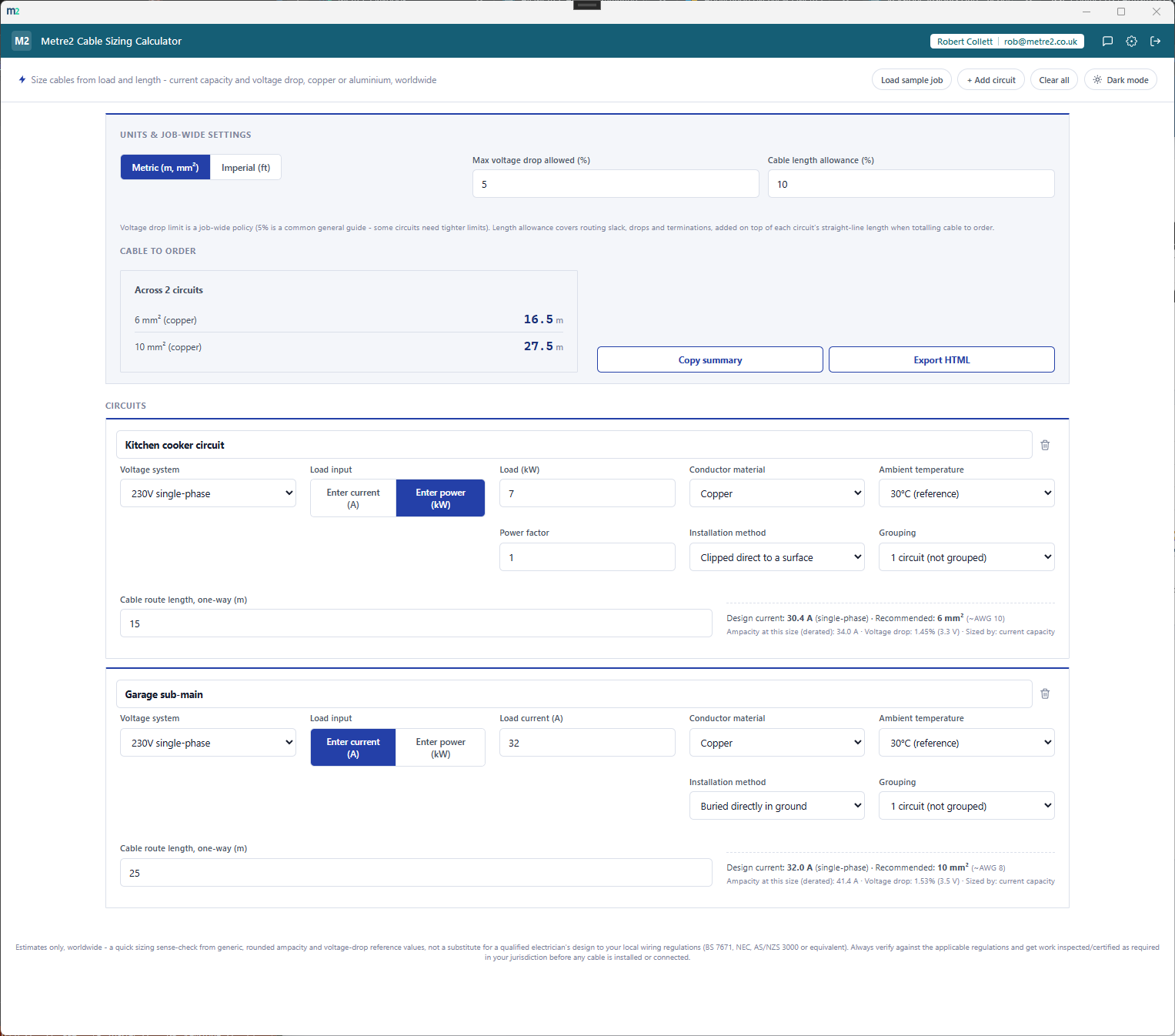
Two very different circuits in one job - a kitchen cooker sized from its power in kW, and a garage supply buried in the ground sized from its current - with cable to order totalled at the end.
The garage run needs a bigger cable than the cooker despite a similar current because burial derates the conductor and the route is longer. Push the garage route out to 90 m and the recommendation steps up to 16 mm², now sized by voltage drop rather than current capacity - the app tells you which constraint won. Open the browser edition to try it with your own figures.
Read the guide: What size cable do I need? Twin and earth sizing to BS 7671 - worked examples for a shower, cooker, garage run and lighting, with correction factors and volt drop.
No - use it straight from your browser, on a phone, tablet or PC, with no sign-up. It works offline once it has loaded, and you can add it to your home screen or desktop like an app. There is also a Windows desktop version in the Microsoft Store if you prefer an installed app.
You don't need one. Install Cable Sizing Calculator from the Microsoft Store and start using it - there's no sign-up. If you'd like to hear about updates you can register your copy with a name and email, but nothing depends on it.
No - it's a design aid, not a certified design. UK twin & earth mode uses the BS 7671 Table 4D5 values; Generic mode is a sense-check from rounded reference values. Always verify against your local wiring regulations (BS 7671, NEC, AS/NZS 3000 or equivalent) and get work designed, inspected and certified by a qualified electrician as required in your jurisdiction.
Yes - pick a voltage system (230V single-phase, 400V three-phase, 120V/240V US split-phase, 415V, 480V, or a custom voltage), copper or aluminium conductor, and metric or imperial units.
In flat twin & earth clipped direct, 4 mm² is rated 37 A and 6 mm² is rated 47 A (BS 7671 Table 4D5), so 4 mm² can carry 32 A on a short run. Long runs often need 6 mm² or more for voltage drop, and cable in insulation or grouped with others is derated - check the run with the calculator above.
Multiply the cable's voltage drop figure (mV/A/m from BS 7671) by the design current and the route length, then divide by 1,000. For 2.5 mm² twin & earth (18 mV/A/m) carrying 20 A over 25 m: 18 x 20 x 25 / 1000 = 9 V, which is 3.9% of 230 V.
BS 7671 Appendix 4 gives 3% for lighting circuits and 5% for other uses when the installation is supplied from the public network - 6.9 V and 11.5 V on a 230 V supply.