How-to guide
When sheets are nested and folded for a saddle-stitched booklet, each one wraps round the sheets inside it, so the inner sheets stick out further at the foredge. After trimming, their outer margins are smaller and anything near the edge can be cut off. Creep (shingling in the US) moves those pages towards the spine to compensate: one paper thickness per sheet wrapped outside them. This guide sets creep on a 16-page A5 booklet in Metre2 Print Imposition Pro.
Open a saddle-stitched booklet. The 16-page A5 sample is one 16-page section (F16-7) on SRA2: four sheets nested inside each other when folded.
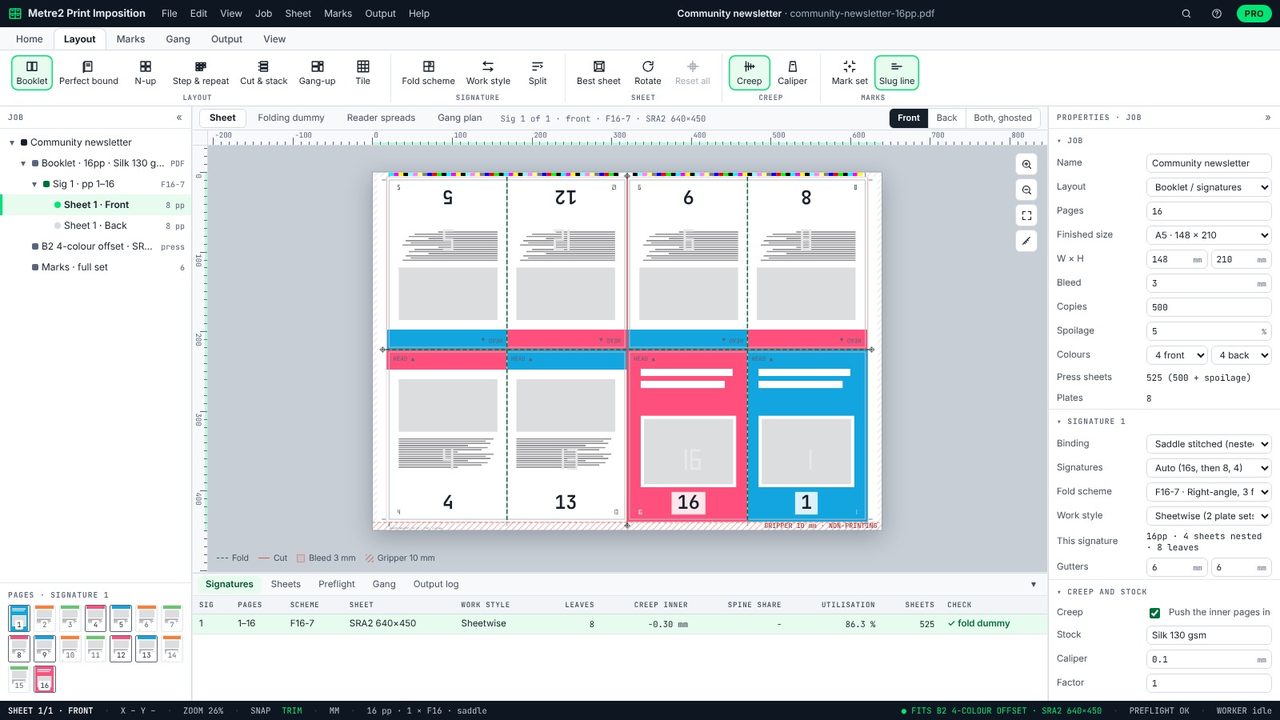
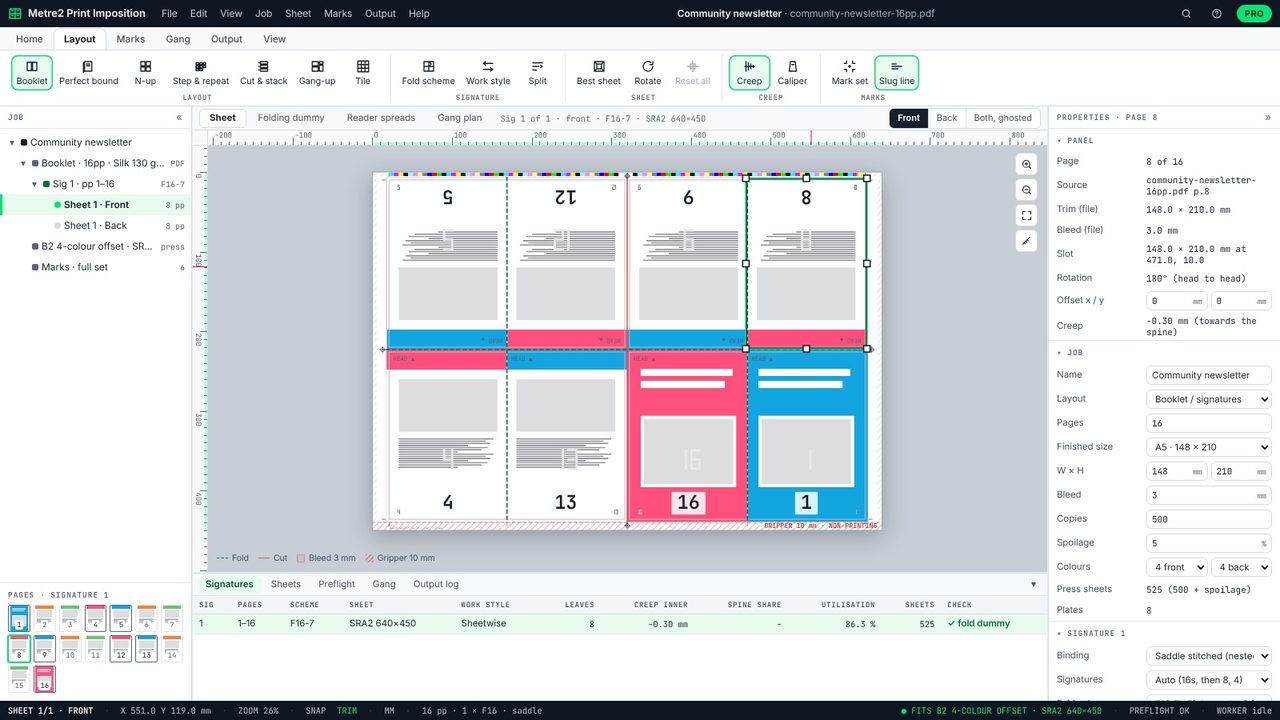
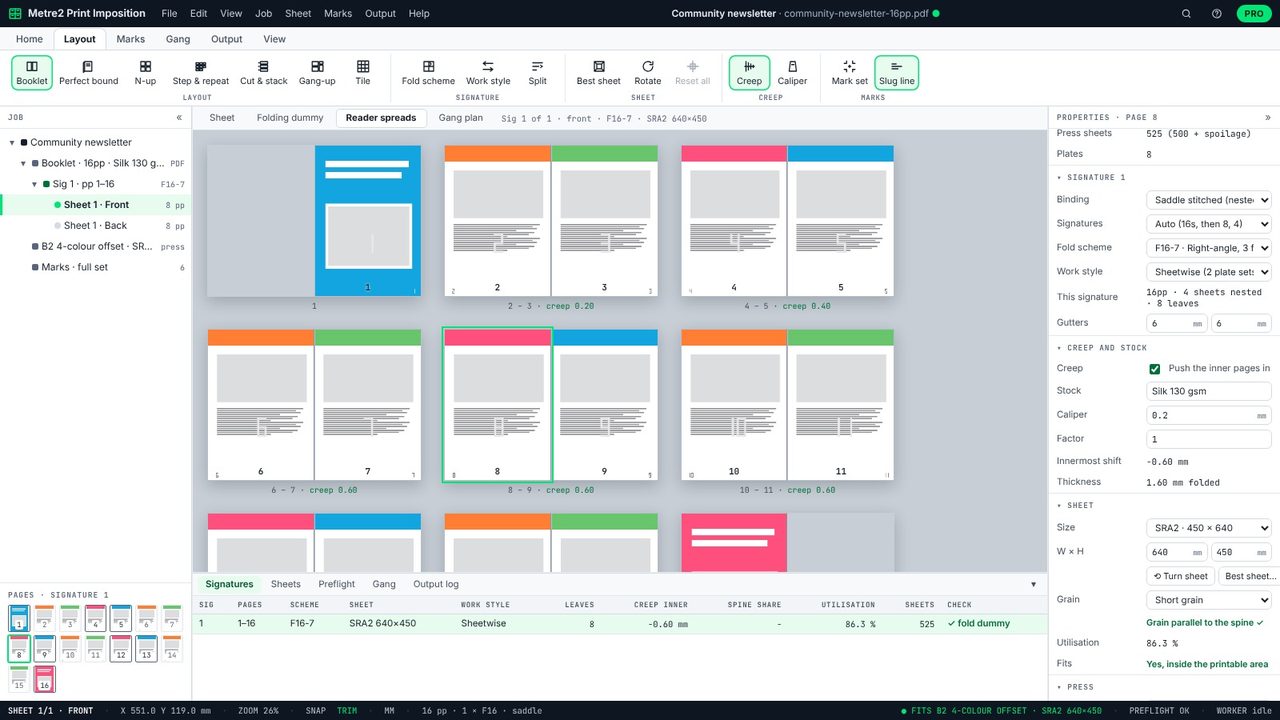
Click page 8. The centre spread (pages 8 and 9) is on the innermost sheet, so it is shifted most: with 0.1 mm paper, 3 sheets wrap round it, so it moves 3 x 0.1 = 0.30 mm towards the spine. The outer sheet doesn't move at all.
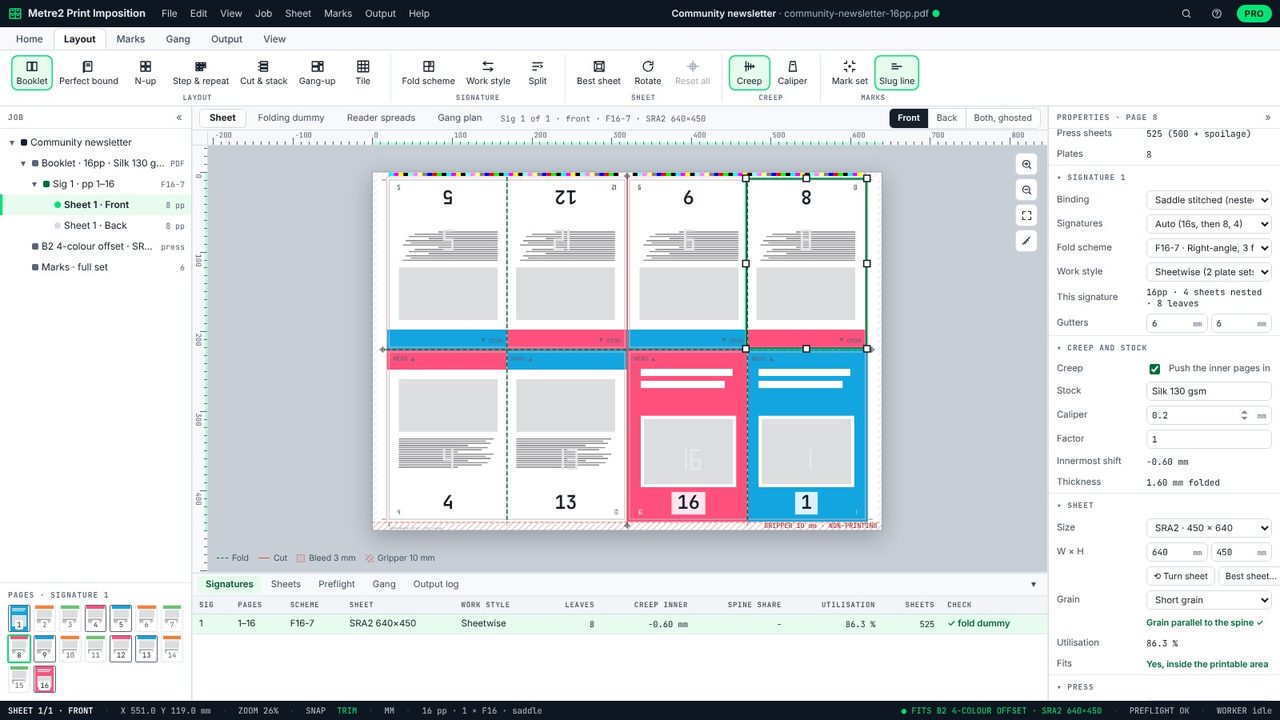
Creep comes from the paper's thickness (caliper), in Properties under Creep and stock. Change it to 0.2 mm for a thicker stock and the innermost shift doubles to 0.60 mm. The folded thickness is shown too. Use the factor for bulky stocks.
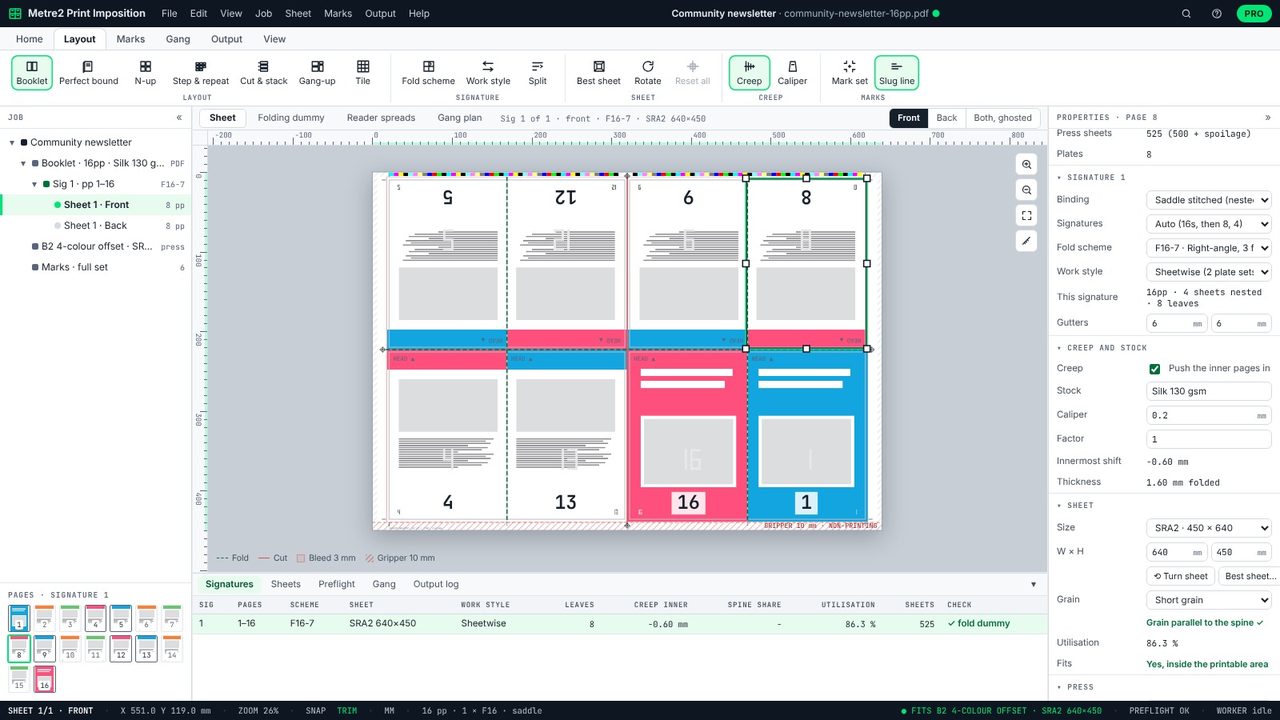
The Signatures table shows the inner creep for each signature. In a booklet of several sections, the inner sections creep more because the outer sections wrap round them as well.
Reader spreads marks the creep on each spread, and the pages are drawn shifted. The imposed PDF moves each page by exactly this much and clips it to its bleed.
In a saddle-stitched booklet the inner sheets stick out at the foredge because the outer sheets wrap round them. After trimming, the inner pages have narrower outer margins. Moving those pages towards the spine to compensate is called creep, or shingling in the US.
Each sheet is moved towards the spine by the number of sheets outside it times the paper's caliper (times a factor for bulky stock). The outermost sheet doesn't move; the centre spread moves most.
Much less: the sections are gathered side by side, not nested, and the spine is ground off. It can still be set within each section.
Creep is in Print Imposition Pro, £14.99 a month or £129 a year with a 7-day free trial.